
 Chattanooga, TN



 (423) 802-8837
TL;DR
Whether to repair or replace a furnace depends first on what your house burns. A gas furnace is a stand-alone decision, and a single failed part like an igniter or blower motor is usually worth fixing. A cracked heat exchanger is not. An electric heat pump is your heating and your air conditioning in one machine, so the same decision covers next summer too. Get the failed part named in writing, then price repair and replacement side by side.
Most homes on Signal Mountain and Walden heat with natural gas, while most homes in Chattanooga, East Ridge and Collegedale heat with electricity, usually through a heat pump that also cools the house. That split changes the math, and so does a federal refrigerant rule that changed in 2026.
What Does Your House Actually Burn?
Look at the equipment before you look at the quote. A gas furnace has a flue pipe running up through the roof or out a wall and a gas line with a shutoff valve at the unit. An all-electric system has neither, and if there is an outdoor unit that runs in winter, you have a heat pump.
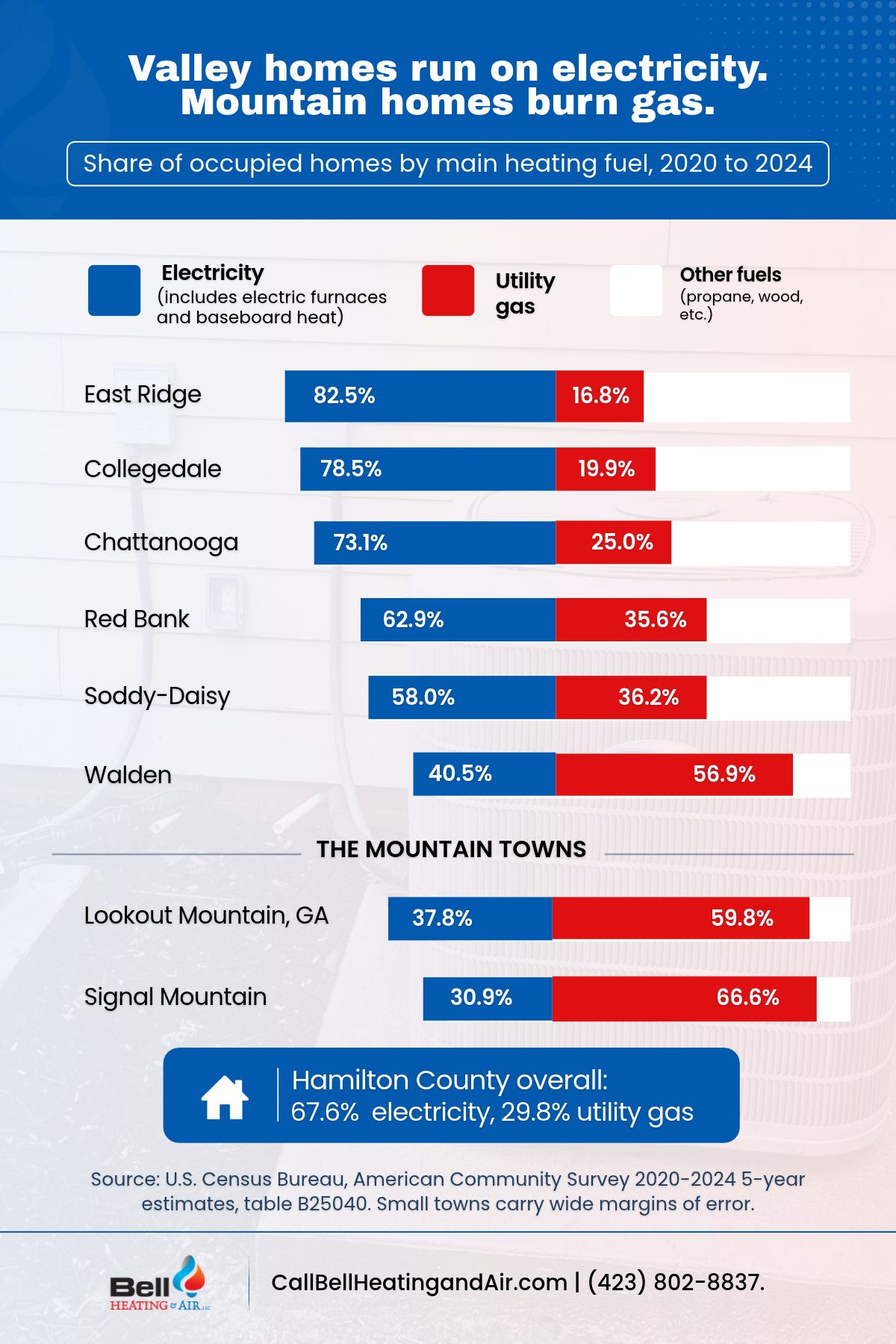
This matters more here than in most metro areas because the Chattanooga area is split. The Census Bureau’s American Community Survey table on house heating fuel (the 2020 to 2024 five-year estimates) counts 154,181 occupied homes in Hamilton County. Of those, 104,185 heat mainly with electricity, about 67.6%, and 45,951 use utility gas, about 29.8%.
The county figure hides the pattern. Break the same table down by town, and the mountain communities flip the valley’s answer.
| Town | Homes counted | Heat mainly with electricity | Heat mainly with utility gas |
| East Ridge | 9,587 | 82.5% | 16.8% |
| Collegedale | 4,304 | 78.5% | 19.9% |
| Chattanooga | 79,084 | 73.1% | 25.0% |
| Red Bank | 6,123 | 62.9% | 35.6% |
| Soddy-Daisy | 5,232 | 58.0% | 36.2% |
| Walden | 719 | 40.5% | 56.9% |
| Lookout Mountain, Georgia | 580 | 37.8% | 59.8% |
| Signal Mountain | 3,351 | 30.9% | 66.6% |
Two cautions on reading it. The small towns carry wide margins of error in the same survey, so treat Walden and Lookout Mountain as a direction rather than a precise share. And “electricity” covers heat pumps, electric furnaces, and baseboard heat together, so the table tells you the fuel, not the machine.
What it does tell you is why the neighbor’s advice may not fit. Someone in Soddy-Daisy with a gas furnace and someone in East Ridge with a heat pump can both say “our heat went out,” and they are facing different decisions.
Gas Furnace: When Is It Worth Repairing?
If you heat with gas, the furnace is the only thing that failed, and a repair or a replacement touches heating and nothing else. That makes the math simpler. It also means most failures come down to a single part.
The problems we list on our own furnace repair page are mostly single components: the ignition system, the pilot light, the blower motor, the thermostat. Each is a part with a price, and a furnace that needs one of them is usually a furnace worth fixing.
The failure that changes the conversation is the heat exchanger, the metal chamber that keeps combustion gases separate from the air you breathe. A cracked heat exchanger is a carbon monoxide risk, not a comfort problem. For most residential furnaces, this is the point where we talk about replacement, because the heat exchanger is the core of the unit and swapping it is a major job in its own right.
Safety first: If anyone in the house has headaches, nausea, dizziness, or flu-like symptoms when the heat is running, do not wait for a diagnosis. Get everyone outside and call 911 or your gas company. Every home with a gas furnace should have working carbon monoxide alarms.
Questions for a gas furnace quote
- Which part failed, by name? “It needs a new board” is an answer. “It’s old” is not.
- Is anything else on the unit showing wear that you would expect to fail soon?
- Did the tech inspect the heat exchanger, and how?
- Does the air conditioner coil sit on this furnace, and would a new furnace change it?
That last one catches people. In a typical gas home, the indoor coil for the air conditioner sits on top of the furnace cabinet, so the two are physically joined even though they are separate machines. If your AC is near its own end of life, pairing the two replacements may make sense. If it is young, a furnace swap should leave it alone, and a good quote says so.
For our Signal Mountain customers, where two-thirds of homes in the same survey burn gas, this is the more common version of the question.
Heat Pump: Why the Decision Covers Both Seasons
A heat pump is an air conditioner that can run in reverse. The outdoor unit and its compressor do the heating in January, and the cooling in July, so a repair decision in October is also a decision about next summer, and about the den full of people on a Saturday afternoon in September.
That is the key difference from a gas home. When a heat pump compressor fails, you are not deciding about heat alone. You are deciding whether to put money into the one machine that carries the house through both seasons.
Across the homes we work on in East Ridge, where more than four in five heat with electricity according to the same Census table, this is the version of the question most households there are facing. The valley answer is really a heat pump answer.
Some electric homes have an electric furnace with a separate air conditioner rather than a heat pump. Those behave more like the gas side: the furnace can be repaired or replaced on its own. If you are not sure which you have, check whether the outdoor unit runs on a cold morning. If it does, it is a heat pump.
The cooling half of this decision is covered in our summer piece on air conditioners, which looks at the same equipment from the July side.
Can You Still Fix an R-410A Heat Pump in 2026?
Yes. Parts for existing R-410A heat pumps are still sold, and an EPA rule published on May 26, 2026, and effective July 27, 2026, goes further. It removes the installation deadline for residential and light commercial air conditioners and heat pumps where all specified components were manufactured in or imported into the United States before January 1, 2025, and it keeps replacement components available so existing systems can be maintained.
Here is the background from EPA’s final rule in the Federal Register. A 2023 rule under the AIM Act restricted new residential systems using refrigerants with a global warming potential of 700 or higher, starting January 1, 2025. R-410A is above that line. The newer refrigerants, R-454B and R-32, are below it. An interim rule then extended the installation date to January 1, 2026, for equipment built before 2025. The 2026 rule drops that cutoff entirely.
The sentence in the rule that matters most for a homeowner is this one: “a homeowner can choose to replace their failed condensing unit rather than purchase a whole new system.” The condensing unit is the outdoor half. Two separate petitioners had asked the agency to consider limiting condensing units for these systems, and the 2026 rule made no change, so the option stands.
The same document records two market facts. It cites a distributors’ trade association reporting that equipment on the new refrigerants reached 90% of market share as the 2025 cooling season ended. And it notes that while supply of R-454B was sufficient, there were problems getting it to contractors in service cylinders, causing scarcity in some regions during 2025.
Three paths when a heat pump fails
| Path | What it means | When it tends to fit |
| Repair the part | Replace the failed component, recharge if needed, keep the system | A single failed part on equipment otherwise in good shape |
| Replace the outdoor unit only | New condensing unit matched to the existing indoor coil and air handler, on the same refrigerant | Compressor or outdoor unit failure where the indoor side is sound |
| Replace the whole system | New matched indoor and outdoor equipment, usually on R-454B or R-32 | Both halves worn, a mismatched system, or a ductwork problem that has to be fixed anyway |
The middle row is the one that changed in 2026. It is only sound if the new outdoor unit is rated to work with the indoor coil you already have, so ask the contractor to name the matched pair.
When the whole system is the honest answer, replacing a heat pump outright means choosing the refrigerant you will live with for many winters. Ask which one the quote uses and why.
What Rebates and Tax Credits Still Apply in 2026?
Two incentive pictures changed between last winter and this one, and a lot of the advice still online predates both.
The federal 25C tax credit is gone for new work. The IRS page for the credit now says you can claim it “for improvements made through December 31, 2025.” Before that, the IRS allowed up to $2,000 a year for a qualifying heat pump and up to $600 for a qualifying furnace. Any quote or article from 2025 that folds that credit into the price is out of date for a 2026 install.
The utility rebate survived. The TVA EnergyRight heat pump rebate page lists these amounts:
| Upgrade | TVA EnergyRight rebate |
| Air source or dual fuel heat pump, 17 SEER2 or higher | $800 |
| Air source or dual fuel heat pump, 15 to 16.99 SEER2 | $500 |
| Ductless mini-split, 17 SEER2 or higher | $800 |
| Tune-up for an existing heat pump or central air system | $50 |
| Duct sealing, repair, insulation, or replacement | $300 |
The catch is who installs it. EnergyRight says every rebate-eligible upgrade must be completed by a member of its Quality Contractor Network, and the contractor files the claim. EPB, the Chattanooga power company, runs the same program for its customers and says network members must initiate your rebate claim within 90 days of completing the project. EPB also lists heat pump systems at $800 or more, with qualifying systems reaching as much as $1,500, so ask which figure applies to the exact equipment you are quoted before you sign.
Two details in the same table are worth reading twice. The $50 tune-up line applies to an existing heat pump, so a repair-and-keep decision can still collect something. And “dual fuel” is on the list, which matters on the mountain: a gas home replacing its air conditioner can look at a heat pump that shares the heating load with the gas furnace.
How Do You Decide? A Worksheet for the Quote in Your Hand
Most people make this call with one number in front of them: the repair price. That is not enough information. Work through these in order and write the answers down.
- Fuel: Gas furnace, electric furnace, or heat pump. The earlier sections tell you which rules apply.
- The failed part, named: Ask the tech to write it on the ticket.
- What else is near failure: One repair on sound equipment is different from the first of three.
- For heat pumps, the refrigerant: Look at the data plate on the outdoor unit or ask. R-410A can still be repaired, and its outdoor unit can still be replaced on its own.
- Both prices, from the same visit: A repair price and a replacement price, each itemized.
- Incentives, current ones: No 25C credit for 2026 work. EnergyRight only through a network contractor.
- A second opinion on anything major: A heat exchanger or compressor call is worth a second look.
If the answers point to repair, fix it and stop worrying about it. If they point to replacement, you now know which kind, and you can compare quotes on the same equipment. Our list of signs you need to call an HVAC contractor covers what usually comes before a failure like this.
Why We Did Not Give You an Age Cutoff
Plenty of guides say to replace any furnace past a certain age, or any repair that costs more than a set share of a new unit. We left those out on purpose. We could not find a primary source for any of the figures in circulation, and they flatten exactly the difference this page is about.
A gas furnace with a sound heat exchanger and a failed igniter is a cheap fix at almost any age. A heat pump with a failed compressor is a large decision even when it is fairly young. Equipment age is a question to ask, not an answer.
Get the Furnace or Heat Pump Diagnosed, Then Price Both Paths
Book the diagnosis before the first cold week, somewhere between the last football weekends and the stretch when the house fills up with family for the holidays. That is when every contractor in the valley is busy, and decisions get made in a hurry. Have the failed part named, check the fuel and the refrigerant, and get the repair and the replacement priced side by side. With gas, you are pricing heat. With a heat pump, you are pricing both seasons at once. A fall maintenance visit is the cheapest way to find out which conversation you are about to have.
If you want us to look at it, start with a furnace repair visit, and we will tell you plainly whether the part is worth fixing. When the answer is furnace replacement, our installation page covers gas furnaces, electric furnaces, and heat pumps, with free estimates and second opinions. We serve Chattanooga, Hixson, Soddy-Daisy, Signal Mountain, and the surrounding towns on both sides of the fuel line. Call (423) 802-8837, request an appointment, or reach Bell Heating & Air to book.
