
 Chattanooga, TN



 (423) 802-8837
TL;DR
Nobody calls an HVAC company because they enjoy the conversation. You call because something in your house stopped feeling right, and you would like a straight answer about why.
So that is what this is. No scare tactics, no countdown clock, no pressure to buy anything today. Just a plain walk through what happens to a house between the start of football season and the last of the holiday guests, and why the comfort problem you have been ignoring since spring is about to have an audience.
The Room Nobody Uses Is About to Be the Room Everybody Is In
For most of the year, the bonus room over the garage is storage with a couch in it. The den is where somebody watches TV alone. The dining room is a table you walk past.
Then the season turns, and those rooms go into service.
Saturday afternoons, fourteen people end up in the room with the biggest screen for the Vols, the Dawgs, the Tide, or the Mocs, and in plenty of Chattanooga houses that is more than one team under the same roof. Sundays it is the Titans or the Falcons. Thanksgiving, everybody stands in a kitchen built for two. Christmas morning, the whole family is in one room for three hours. And every one of those rooms is the room somebody in your house has quietly complained about for years, because it never held temperature right and nobody made an issue of it while it was empty.
That is the thing about comfort problems. They are easy to live with until the day you have company.
What a Full House Actually Does to Your Heating and Air
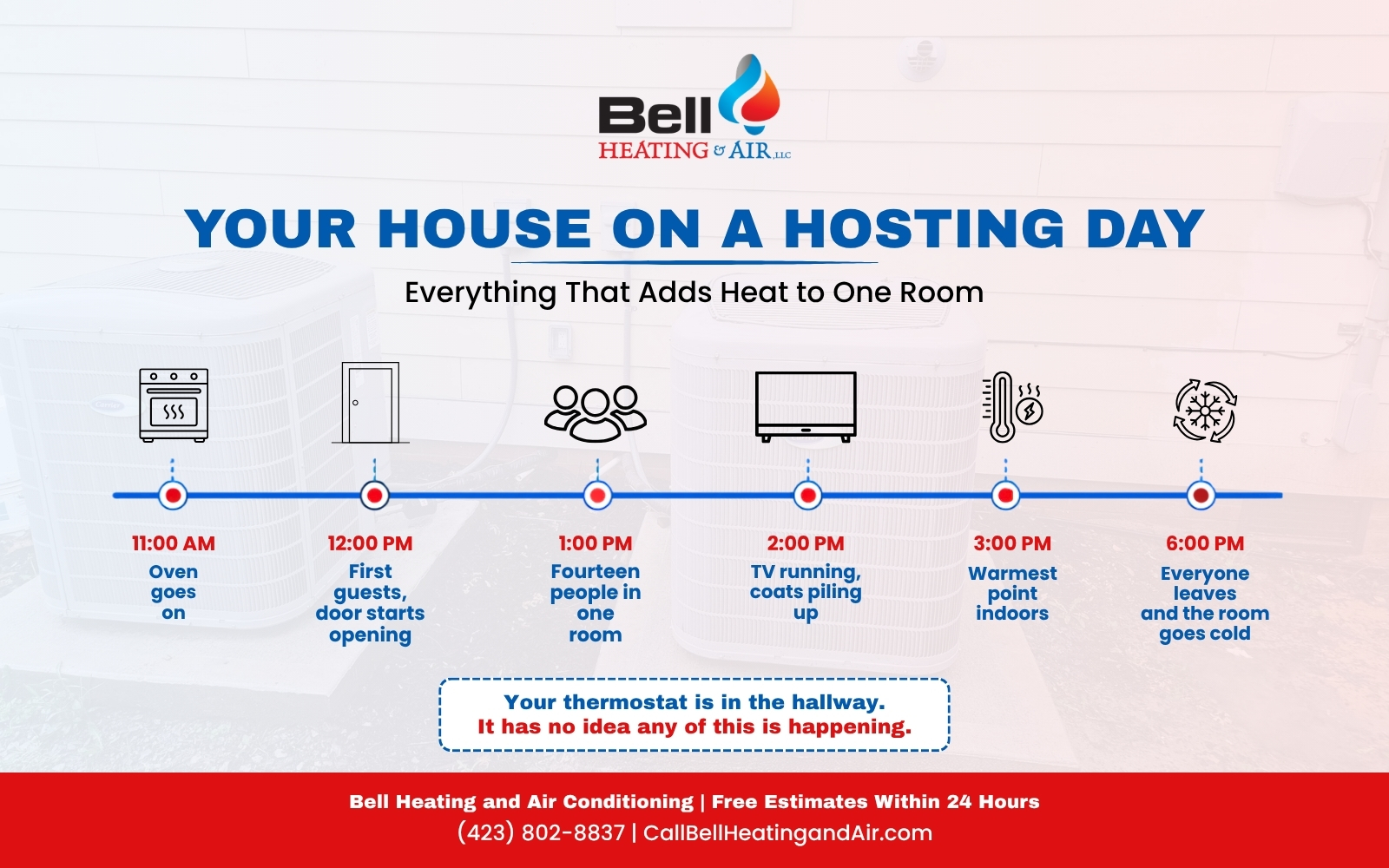
A room full of people is a room full of small heaters. Every adult on your couch puts out roughly as much heat as a lamp left on, and fourteen of them in one den adds up to real warmth your system was never asked to handle in that room.
Then add the rest of it. The TV has been on for six hours. The oven has been on longer. The front door opens forty times in an afternoon, and every time it does, air you paid to condition walks outside. Halloween is the one night it more or less stays open, unless everybody is at a trunk-or-treat or out walking one of the haunted houses. Coats pile up on a bed and hold heat. Somebody lights the fireplace because it looks nice, not because the room needs it.
Meanwhile, your thermostat is in the hallway.
That is the whole mechanism, and it explains most of what goes wrong on a hosting day. The thermostat reads a quiet, empty hallway, decides the house is comfortable, and shuts the system off. The room with all the people in it keeps getting warmer, and nobody can work out why turning the temperature down is not helping. It is not helping because the system already thinks it is finished.
Why It Gets Warm Around Halftime
There is a pattern to it, and once you notice it, you cannot stop noticing it.
The room is fine when people arrive. An hour in, somebody takes off a jacket. By the middle of the afternoon, somebody has cracked a window in November, which tells you everything you need to know. Then the game ends, everyone leaves, and within twenty minutes that same room is the coldest one in the house.
Both halves of that are the same problem. The room does not have enough air movement to shed heat when it is full, or to recover when it empties. It is running on whatever air happens to reach it, and on a normal Tuesday that is enough, because there is nobody in there.
The fixes are usually smaller than people assume. Sometimes a room is being starved because a run of ductwork got pinched years ago. Sometimes there is a supply vent and no real return, so air goes in with nowhere to go. Sometimes it is a damper somebody adjusted in 2019 and forgot about. We find that one more often than you would think.
The Thanksgiving Kitchen Problem Nobody Plans For
An oven at 350 for six hours is a heat source your house does not deal with any other week of the year. Four burners going alongside it. A dishwasher running twice. Two dozen people rotating through the one room where all of that is happening.
If your kitchen is open to the living area, which most houses built in the last thirty years are, that heat does not stay in the kitchen. It moves into the room where everyone is sitting and brings the humidity from six hours of boiling and roasting with it. Then somebody runs the range hood, which pulls conditioned air out of the house and draws unconditioned air in through every gap it can find, and now the far end of the house has gone cold while the near end is stifling.
None of that means anything is broken. It means the house is being asked to do something unusual, and whatever was already marginal shows up first.
Worth knowing before the day rather than during it.
Why the Air Feels Heavy Even When It Is Cool Outside
Temperature and moisture are two different problems, and your system only handles one of them on purpose.
It pulls water out of the air while it is running, and only while it is running. In July, when it is 95 outside, it runs long stretches and the house dries out as a side effect. Once the afternoons cool off, it hits your setpoint in eight minutes and shuts off. Same house, same equipment, far less moisture removed.
Now put twenty people and a working kitchen in that house. People add moisture just by being in a room. Cooking adds more. Wet coats and boots by the door, after an evening skating at Ice on the Landing or walking the Enchanted Garden of Lights at Rock City, add more. So you end up with a space that reads a perfectly reasonable temperature and still feels close and stuffy, and everyone blames the crowd.
Comfortable sits between 40 and 50 percent humidity. Past 60, you notice it in the air, on the windows, and in how a room feels ten minutes after you walk into it. If your windows fog when you host, that is not the cold outside. That is the moisture inside having nowhere to go.
The right fix depends on the cause. Sometimes it is a fan setting. Sometimes it is ventilation. Sometimes the honest answer is a whole-home dehumidifier, which handles moisture on its own and does the job your air conditioner never will. We would rather find out which one it is than guess.
When Should You Turn the Heat On in Tennessee?
Most homes around here make the switch when overnight lows settle into the low 50s for several nights running, which usually lands in the second half of October. The weeks before that are the in-between, where you might cool in the afternoon and take the chill off in the morning.
There is one thing worth doing before you need it, and almost nobody does it.
Pick a mild fall day, set the thermostat to heat, and let it run fifteen or twenty minutes. You are checking three things. Does it come on? Does the air coming out actually feel warm? And does it smell like burning dust for a couple of minutes and then stop, which is normal, or keep going, which is not.
Run that test on a 70-degree afternoon and, if something is wrong, you find out on a Tuesday with your whole week open. Skip it, and you find out at ten at night on the first cold Friday, with people coming over the next day.
If the heat does not come on, or the air is cool, or the smell lingers, call us. Free estimates within 24 hours, and emergency response in 2 to 4 hours.
The Weeks When Your House Tells On Itself
There is a stretch in early fall where the system genuinely goes back and forth. Cooling one afternoon, heat the next morning, cooling again by lunch. Homeowners find it annoying. We find it useful, because a house swinging both directions inside a day shows things that a steady summer or a steady winter hides completely.
Worth noticing during those weeks:
- Which rooms are last to catch up, in either direction
- Whether the system runs noticeably longer than it did last fall to get there
- Any sound it did not make a year ago
- Whether the air smells different once the heat has been running a few minutes
- How the house feels in the morning compared to the evening at the same setting
Bring that list to a service call, and you have handed us a week of information about your house. It genuinely changes what we look for.
What We Look At When We Come Out
A comfort complaint and a breakdown are two different jobs. When a system is down, the work is to get it running. When one room is wrong, or the air feels heavy, the work is to figure out why, and that takes a different order of operations.
The conversation before the toolbox comes out
Which rooms. What time of day. Whether it is worse when the house is full. What changed recently. That conversation regularly saves an hour of hunting, and it is the part most companies skip because it does not look like work.
How well air is actually moving
We measure it rather than guess at it. If the system is straining to push air through the house, that shortens its life and starves the rooms farthest away, which is usually the exact room everybody sits in on a Saturday.
The ductwork, start to finish
Attic and crawlspace both. We are looking for connections that came apart, runs that got pinched, insulation that slumped off, and rooms with a supply vent but no real return.
The equipment
The full inspection, including everything on the safety side for gas systems. This is the part everyone expects, and it matters, though it is rarely where a comfort problem actually lives.
The room itself
Sun exposure, insulation, windows, ceiling height, what is above and below it, and how many people are typically in it. A bonus room over a garage with twelve people in it is a different problem than the same room empty.
What we found, in writing
You get what we found and what it means in plain language, along with the options. If there are three ways to go, you hear all three and what each one does. Then you decide. Nobody at this company works on commission, so there is nothing to push.
What a Fall Heating Tune-Up Includes
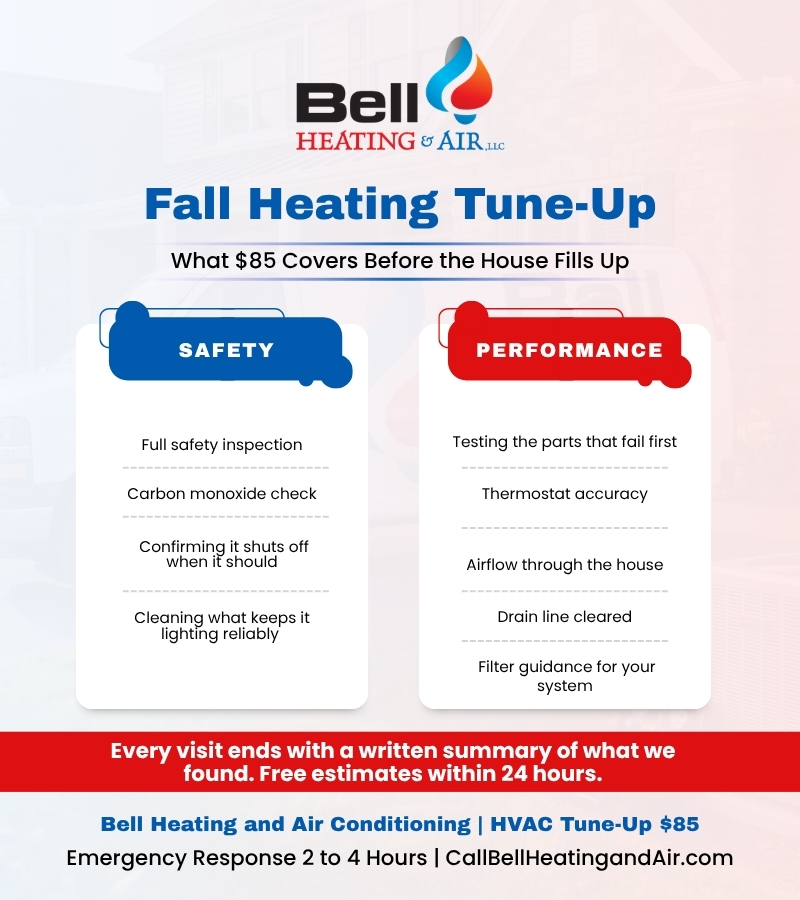
Our HVAC tune-up is $85, because “tune-up” means very different things depending on who is saying it. Here is what our seasonal HVAC maintenance in Chattanooga actually covers, in plain terms.
- A full run of the system in heat mode, start to finish
- Every safety check a gas system needs, including a carbon monoxide check
- Cleaning the parts that get dirty and stop the system from lighting reliably
- Testing the electrical parts that fail most often, before they do
- Checking that the thermostat is telling the truth
- A look at your filter and straight guidance on the right one for your system
- Clearing the drain line so it does not back up later
- Confirming air is moving the way it should through the house
- A written summary of what we found
If everything is fine, we tell you everything is fine, and you have it in writing. That happens often, and it is a perfectly good outcome for an $85 visit before a season of hosting.
Are Your Ducts the Real Problem?
Older duct systems can lose twenty to thirty percent of the air moving through them. That is air you already paid to heat, ending up in an attic or a crawlspace where it does you no good at all, and it is usually why the far end of the house never keeps up.
In a house built between the mid-nineties and the mid-2000s, which covers a lot of the neighborhoods we work in, the ductwork has had twenty years for seals to dry out and connections to loosen. Nothing dramatic happens. A joint separates by half an inch. A connection pulls back from a vent. A flexible run sags over a beam and the air has to climb through it.
Signs worth paying attention to:
- The rooms farthest from the unit are always the worst, in both seasons
- A vent that barely moves a tissue held up to it
- Power bills climbing year over year with no change in how you use the house
- Dust back within days of cleaning, which your guests will notice before you do
- An attic or crawlspace that feels heated or cooled when it should not
- Whistling or rushing sounds at the vents
Duct repair is usually the cheapest real comfort improvement available in an older home. It is also the least exciting, which is probably why it gets recommended less often than a new system does. We handle duct repair, custom ductwork, and zoning across the greater Chattanooga area, and in plenty of homes it is the only thing we end up recommending.
Rooms That Need Their Own Answer
Some rooms will never match the rest of the house through the ductwork you have, because that ductwork was never built to serve them. The bonus room over the garage is the classic, and it is also the room that becomes the game room every Saturday from now until January.
Two honest options exist for a room like that.
Zoning splits your existing system into separately controlled areas, so upstairs and downstairs stop fighting over one setting. It works well in two-story homes where both floors are otherwise served properly, and it means the crowd upstairs can be comfortable without freezing out whoever stayed down.
A ductless mini-split gives that room its own system. No new ductwork, no tearing into walls, and no change to the equipment serving the rest of the house. One unit outside, one inside, its own thermostat, heat and cool independently. For a bonus room, a converted garage, a finished basement, or a sunroom that only gets used when company comes, it is usually the right call, and they tend to last fifteen to twenty years.
We install and service ductless systems from American Standard and Mitsubishi Electric. We will also tell you plainly when a room does not need one.
Air Quality Goes Down When the House Fills Up
More people means more of everything moving through the air. Dust that had settled gets stirred back up by foot traffic. Coats and shoes bring pollen in from outside. Cooking puts particles in the air for hours. Candles and a fireplace add more. And the whole time, your system is circulating all of it through a filter that has been in there since who knows when.
Somebody in that room is going to have a rough afternoon, and it will get blamed on the dog or the weather.
A few things genuinely help. The right filter for your system, changed on a real schedule rather than when you remember. Better filtration or an air purifier for a household with someone sensitive. Humidity kept in a comfortable range, since dry winter air irritates and damp air feeds mold. And a look at the ductwork if the dust keeps coming back no matter what you do.
The filter is the thing most homeowners get wrong, and it is worth saying plainly: a filter too dense for your system chokes the airflow and creates the exact comfort problem you were trying to solve. Right filter for the equipment, changed every one to three months. That is the whole thing.
Repair or Replace Before You Host?
Repair generally makes sense when the system is under ten years old, the repair costs a good deal less than a replacement would, and it has not needed several repairs in the last couple of seasons.
Replacement starts making more sense at thirteen years and up, when repairs are stacking, when a single repair approaches half of what a new system costs, or when the system has never actually kept the house comfortable in the first place. That last one matters more than people think. If a system has been undersized for the house since the day it went in, repairing it just buys another year of the same holiday.
What we will not do is use the calendar against you. Nobody should be told they have to decide on a new system this week because relatives are coming. If your system is eight years old and running fine, it is not your problem this year, and anyone telling you otherwise is selling something. If it is fifteen and struggling, we will say that too, and you will hear the range of options rather than one number on a page.
Either way, you get the reasoning behind the recommendation, not only the recommendation.
What You Can Do Yourself Before the First Party
Useful, free, and none of it needs a tool you do not already own.
- Change the filter. If you cannot see light through it, it has been too long. Use the size and type your system calls for, not the priciest one on the shelf.
- Run the heat for fifteen minutes on a mild day, well before you need it.
- Walk the house and open every vent and return, including in the rooms nobody has used since spring. Closing vents does not save money; it makes the uneven room worse.
- Move furniture off the vents in the room people will actually sit in. A couch pushed back against a wall in July is often sitting on a supply.
- Clear leaves and grass clippings back two feet from the outdoor unit.
- Look at the drain line for standing water or a drip where there should not be one.
- Replace the thermostat batteries if it takes them. A weak battery causes odd behavior that looks exactly like a failing system.
The rest belongs to a technician, mostly for safety reasons, and that is what the $85 visit is for.
Why We Built the Company Around Two Visits a Year
Spring for cooling, fall for heating. That rhythm is not a package we invented to sell more visits. It is the honest service interval for a system that runs four to five months of cooling and three to four months of heating in a climate like this one.
What twice a year buys you is small problems staying small. A part drifting out of spec gets caught before it takes something expensive with it. A drain line starting to clog gets cleared before it backs up into a ceiling. Something dirty gets cleaned before it locks the system out on the coldest night of the year, which in our experience is almost always the night before people are coming over.
It also means that when you do call with a problem, we already know your house. We know how old the system is, what we found last time, what we recommended, and what you decided. That conversation starts in a completely different place than a first visit does.
Ten years in the greater Chattanooga area and 4.9 stars across 142 Google reviews, most of it from households we see twice a year rather than one-time emergency calls.
Serving Greater Chattanooga and North Georgia
Same standard, same response times, same conversation, wherever the house is.
Hamilton County and the Chattanooga Core
- Chattanooga, TN
- Hixson, TN
- East Ridge, TN
- East Brainerd, TN
- Red Bank, TN
- Signal Mountain, TN
- Walden, TN
North Hamilton County and the Soddy Daisy Corridor
- Soddy Daisy, TN
- Sale Creek, TN
- Lakesite, TN
- Middle Valley, TN
- Harrison, TN
East Hamilton and Bradley County
- Ooltewah, TN
- Collegedale, TN
- Georgetown, TN
- Cleveland, TN
- East Cleveland, TN
- South Cleveland, TN
Sequatchie Valley
- Dunlap, TN
- Whitwell, TN
- Fairmount, TN
North Georgia
- Rossville, GA
- Lakeview, GA
- Lookout Mountain, GA
Residential and commercial, regardless of job size or where the property sits.
Ready to Schedule?
If there is a room in your house that everybody is about to be sitting in, and you already know it is going to be a problem, this is the month to deal with it. HVAC tune-up is $85. Free estimate within 24 hours. Emergency response in 2 to 4 hours with 10 percent off the repair.
Call or text (423) 802-8837, and we will get you on the schedule before the house fills up. Bell Heating and Air Conditioning. Family-owned. Greater Chattanooga. Since 2015.
