
 Chattanooga, TN


 (423) 802-8837
 TL;DR
A whole-house humidifier is worth it in a Chattanooga home when winter indoor relative humidity sits below about 35 percent, and the house shows it: static shocks, gaps opening in hardwood, cracks at trim joints, dry sinuses that clear the moment you leave. It is not worth it if a hygrometer says the house already holds 40 percent through January, and it becomes actively harmful if it is set too high. The EPA puts the working range at 30 to 50 percent, below 60 percent. Winter narrows that further, because moisture that meets cold glass turns back into water.
How Dry Does A Chattanooga House Get In January?
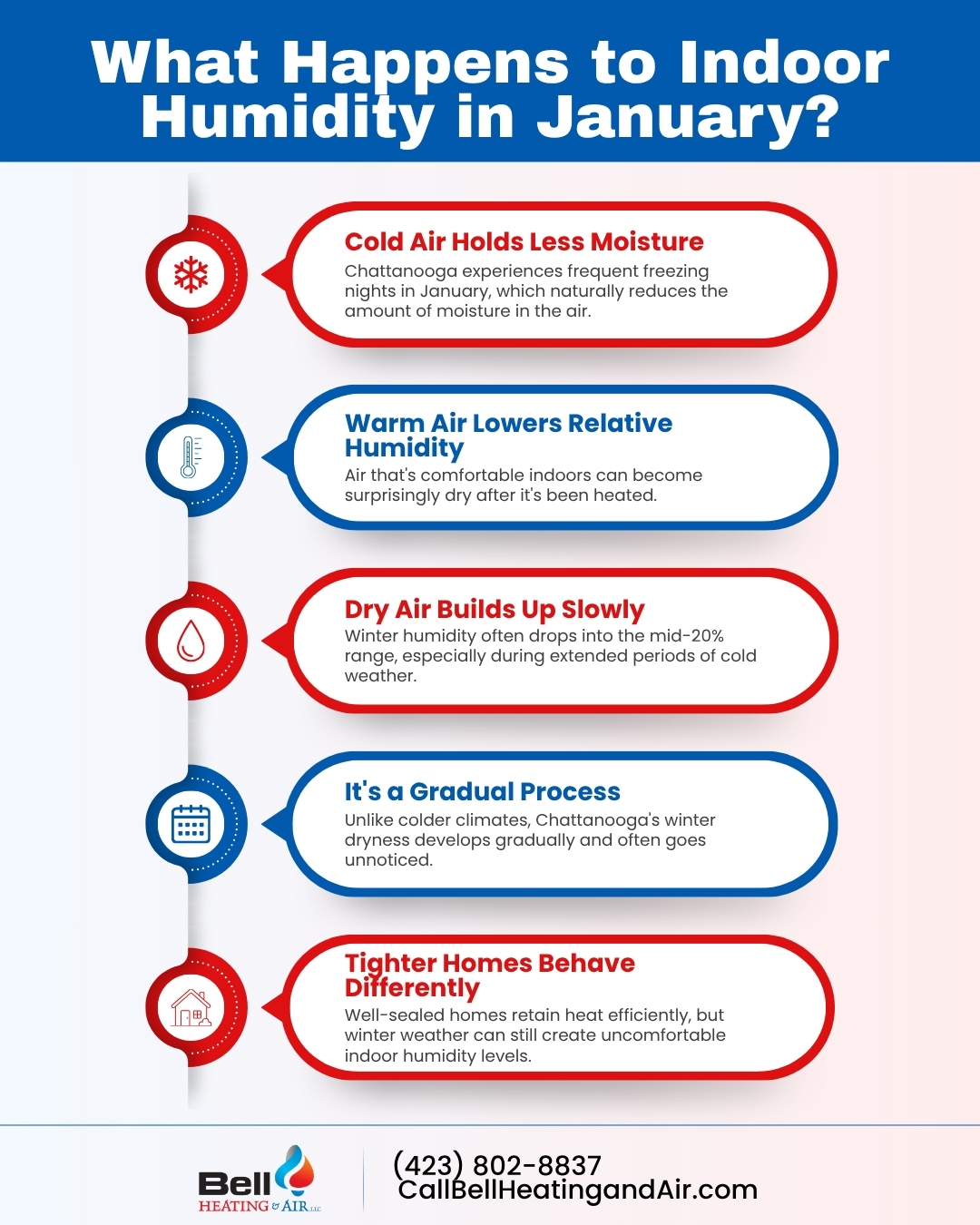
Dry enough to strip a house, and the arithmetic is not close. Chattanooga’s January normal low at Lovell Field is 32.4 degrees, and the normal high is 51.0, with 17 nights at or below freezing, per NOAA’s National Centers for Environmental Information and its 1991 to 2020 monthly climate normals for that station. Cold air cannot hold much water. Heat it to 70 degrees indoors, and the relative humidity collapses.
Run the numbers on a normal January night. Outdoor air at 32 degrees, saturated at 100 percent relative humidity, carries a fixed amount of water vapor. Warm that same air to 70 without adding a drop, and it lands near 24 percent relative humidity, because relative humidity measures how close air is to saturation and saturation rises sharply with temperature. The National Weather Service makes the same point with dew point: the same moisture reads 100 percent at 30 degrees and half that at warmer temperatures.
Our winters are not Minnesota’s, which is exactly why this gets missed here. Chattanooga logs 722.5 heating degree days in a normal January, so furnaces run in long stretches rather than continuously, and the drying happens quietly across weeks instead of arriving as a shock in one cold snap. A house in Soddy Daisy or Ooltewah can sit in the mid-20s for relative humidity from Christmas through February, and nobody names the cause.
Coming in chilled from an evening at the Rock City holiday lights and nudging the thermostat up a few degrees makes it worse, because warmer air holding the same moisture reads even drier.
Tight houses fare worse, which surprises people who paid for the tightness. A leaky 1960s ranch in East Ridge pulls in outdoor air all winter, and that air, once heated, is dry. A well-sealed 2019 build in Ooltewah holds whatever moisture the occupants make, which helps, right up until a week of hard freeze.
What The Dryness Is Actually Doing To Your House
Three things, and only one of them is about comfort.
The shocks come first because they are the most obvious. Dry air is a poor conductor, so the charge you build walking across carpet has nowhere to go until you touch a doorknob. This is not a trivial complaint, and the standards writers agree. ASHRAE Standard 55, which defines thermal comfort for the whole industry, sets no minimum humidity at all. “There are no established lower humidity limits for thermal comfort,” it says, so the standard specifies no minimum level. Read the next sentence in ASHRAE’s own addendum to Standard 55, and it names the reasons anyway: “skin drying, irritation of mucous membranes, dryness of the eyes, and static electricity generation may place limits on the acceptability of very low humidity environments.”
That is a useful thing to know before you buy anything. The comfort standard says dry air will not make you feel cold on paper. Your skin, your eyes, and your knuckles get a vote regardless.
The second thing is the woodwork, and this is where dry winters get expensive. Wood is hygroscopic. It gives up moisture to dry air and shrinks as it goes, then takes it back in summer and swells. Trim opens at the miters, panel doors show an unpainted stripe where the panel has pulled back from the stile, and hardwood develops thin gaps between boards that were tight in October.
Flooring manufacturers write this into the warranty in plain language. Johnson Hardwood’s published engineered wood flooring installation guidelines, revised March 2025, require 60 to 80 degrees Fahrenheit and 35 to 55 percent relative humidity “for the life of the installation”, and warn that below 35 percent you may get “Gapping due to shrinkage, checking, cracking, splitting, splinters, warping, bowing”. Failure to hold those conditions voids coverage. If you have a wood floor under a Tennessee winter, the humidity number is a warranty condition, not a preference.
Third, dry air changes how warm the house feels, which is why the thermostat creeps up in January, and the gas bill follows. That effect is real but modest, and anyone selling you a humidifier on fuel savings alone is stretching it.
The Number To Aim For, And The One To Stay Under
Aim for the low 40s in mild winter weather and let it fall into the 30s during a hard freeze. That range comes from two places that do not sell equipment. The EPA guidance quoted above says indoor relative humidity “should be kept below 60 percent, ideally between 30 percent and 50 percent, if possible”. The Department of Energy’s Building America Solution Center, run by Pacific Northwest National Laboratory, puts the ideal range in homes at 35 to 50 percent in its cold-weather humidity guide.
Notice that the two ranges overlap but do not match, and that neither is a single target. Anyone who tells you 45 percent is the correct answer for every house on every day of winter has skipped the part that matters.
ASHRAE’s comfort standard removed its upper humidity limit for thermal comfort entirely, pointing instead to the ventilation standards, 62.1 and 62.2, for humidity limits tied to air quality. Comfort and health are answering different questions here. Comfort says you can be comfortable at almost any humidity. Air quality says the top of the range is where the damage starts.
Where More Moisture Turns Into A Problem
Moisture only stays airborne while surfaces are warm enough to keep it there. Cool a surface below the dew point of the air touching it and water forms on that surface, which in a Tennessee January means your windows first, then the wall behind furniture on an exterior corner. This is the failure mode nobody selling humidifiers puts on the page, and it is the reason a humidistat exists.
Dew points at 70 degrees indoors, calculated from the standard psychrometric relationship the National Weather Service office in La Crosse explains:
| Indoor RH at 70 F | Dew point | What it means on a cold night |
| 20% | 27 F | Nothing condenses. Everything else is too dry |
| 30% | 37 F | Safe on most windows here |
| 35% | 41 F | Comfortable, still safe on double glazing |
| 40% | 45 F | Fine in mild weather, wet single-pane glass in a freeze |
| 50% | 51 F | Too high for a freezing night, condensation likely |
Now put a Chattanooga cold snap against that table. On a 25-degree night, single-pane glass and aluminum frames can sit in the 30s, and older windows in a Signal Mountain or St. Elmo house often do. Hold the house at 45 percent through that night, and you will find water on the sills in the morning. Do it every night for a season, and you get rotted sills, stained drywall, and mold in a wall cavity you cannot see.
The equipment itself carries risk too. The same Building America library is blunt in its ventilation guide, where humidification “can threaten IAQ when the system malfunctions, is operated at a higher humidity setting than appropriate, or is allowed to develop biological growth.” A humidifier is a water appliance living inside warm ductwork. Neglected, it is a wet surface in the dark with air blowing over it.
So the honest version of the sales pitch is narrower than the one you will read elsewhere. Adding moisture fixes a real problem. Adding too much creates a worse one, in places you will not notice for two years.
Is A Whole House Humidifier Worth It For Your Home?
Buy one if a hygrometer reads under 35 percent through most of the winter and the house shows the damage: gapping floors, splitting trim, static, morning nosebleeds. Skip it if the readings sit at 40 percent already, if you run a wood stove or gas logs that already dump moisture indoors, or if your windows fog on cold mornings without any help.
Measure before deciding. A cheap digital hygrometer in the main living space and a second one in a bedroom, read across a week of genuinely cold weather, settles the question in a way that a symptom list never will. Guessing is how people end up with a humidifier fighting a house that never needed one.
The house style matters as much as the readings. Older homes in Red Bank and Brainerd with original windows leak enough that they rarely reach the 20s, and they punish over-humidification hardest because their glass is coldest. Newer construction in Ooltewah and Harrison holds humidity well and can be brought up several points with very little water, which also means it can be overshot quickly.
This is the point where the job stops being a shopping decision. Sizing to the house volume, tying into the supply or return, running a water line and a drain, and wiring the humidistat so it only calls while the furnace is heating is whole-home humidifier installation work, and it is easy to get wrong in ways that show up as a wet duct rather than an error code. If the humidity swing runs the other way in August, the summer half of the problem is a different machine again.
Bypass, Fan-Powered, or Steam
Three types get installed in homes here, and they are not interchangeable.
| Type | How it adds moisture | Trade-off |
| Bypass | Furnace air is routed across a wet evaporator panel and back into the supply | Cheapest to install and to run, adds nothing while the furnace is idle, needs a bypass duct |
| Fan-powered | Its own small fan pulls air across the panel | Adds more moisture per hour than bypass, no bypass duct needed, uses a little electricity |
| Steam | Boils water and injects vapor into the duct | Highest output and the tightest control, works independently of the burner, costs the most to run |
For most Chattanooga houses on a gas furnace, a bypass or fan-powered unit tracks the heating season well, because the furnace runs often enough in December and January to carry the moisture. Steam earns its place in a large house, a house with a heat pump moving cooler supply air, or a house where the readings will not come up no matter what the panel does.
Living With One Through A Tennessee Winter
Set the humidistat by the weather, not once in November. Somewhere around 40 percent works for a normal week here, and it needs to come down toward 30 to 35 when a hard freeze arrives. Units with an outdoor sensor make that adjustment themselves, and if your thermostat controls humidity, you can watch the number instead of guessing at it.
Windows are your instrument. Light fog at the very bottom corner of a pane on the coldest morning of the year is acceptable. Water running down the glass, frost on the frame, or damp at the sill means turn it down today, whatever the display says.
The water panel is the one maintenance item that gets forgotten. It scales up, and Tennessee Valley water leaves plenty behind, so it wants replacing every heating season, along with a check that the drain is clear and the solenoid closes. We handle that during a furnace maintenance visit rather than as a separate trip. Come spring, shut the humidifier down and close the bypass damper, or it will quietly feed moisture into a house that is already heading for a muggy Tennessee summer.
One more thing worth checking while you are at it: a house that is very dry in winter and very stuffy in summer often has a ventilation services problem underneath both symptoms.
Sorting Your Winter Humidity Before The First Cold Snap
November brings the first freezing nights of the season, and by then the fall service calendar in Soddy Daisy and Hixson is full. Buying a hygrometer now and logging a few readings through the first genuinely cold week gives you real numbers to work from instead of a memory of last January’s shocks. If the readings come back in the 20s, you have a problem worth fixing. If they come back in the 40s, you have saved yourself the cost of fixing a problem you do not have. Either way, Bell Heating & Air can measure the house, size the equipment to it, and set the humidistat so the number stays where it belongs across a full Tennessee winter.
