
 Chattanooga, TN



 (423) 802-8837
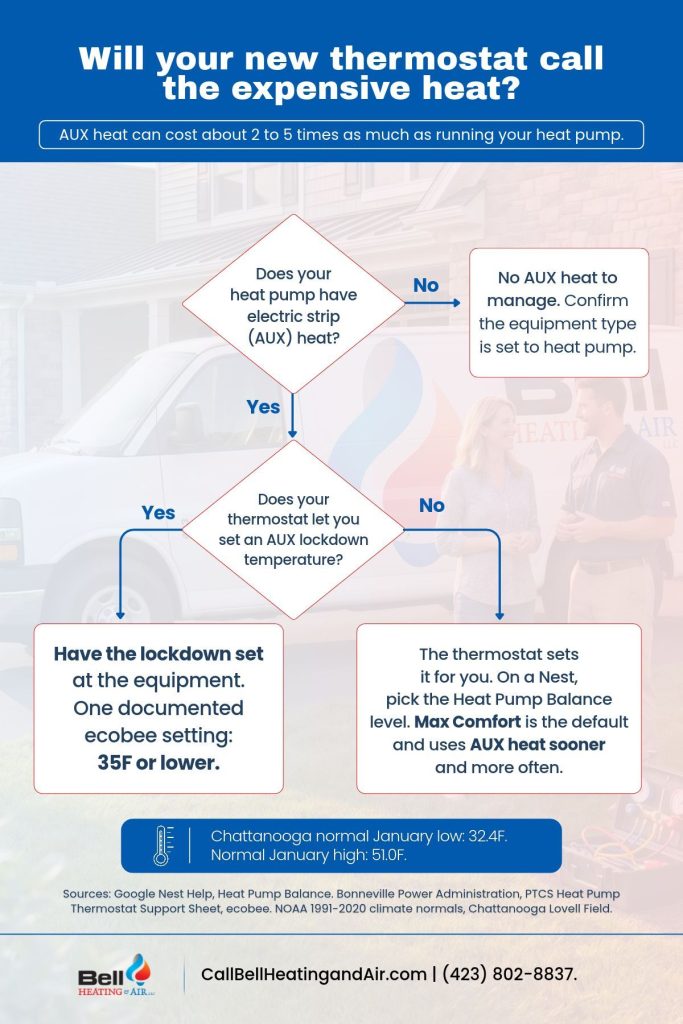
A smart thermostat does not raise a heat pump bill by itself. The bill climbs when the thermostat calls for auxiliary heat, the electric strip heater inside the air handler, more often than the old thermostat did. Google’s own Nest documentation says that backup heat can cost about 2 to 5 times as much as running the heat pump. Three setup screens decide how often it comes on during a Chattanooga winter, and they are the same three whether we installed the thermostat or it came off a store shelf.
TL;DR
A smart thermostat for heat pump homes around Chattanooga saves or costs money depending on three settings: the equipment type and wiring, the auxiliary heat lockout, and the schedule. Auxiliary (AUX) heat is the electric strip backup, and Google Nest Help puts its cost at about 2 to 5 times the cost of running the heat pump. Nest ships with Heat Pump Balance on Max Comfort, the level that brings AUX heat on sooner and more often. A federal installer sheet for ecobee shows an AUX threshold of 35F or lower as one documented setting. Chattanooga’s normal January low is 32.4F, so cold-morning recovery is where the strips get called. The fourth choice is Smart Thermostat Rewards, which, according to TVA EnergyRight, pays a $65 enrollment rebate in exchange for adjustments of up to four degrees.
Why Does a Heat Pump Bill Jump After a New Thermostat?
Because the new thermostat is calling auxiliary heat when the old one did not. A heat pump moves heat from the outdoor air into the house, and most ducted systems around here also carry an electric resistance heater in the air handler as backup. The thermostat decides when that backup runs. Swap the thermostat, and you swap that decision, even though nothing about the equipment changed.
The Google Nest Help page on Heat Pump Balance is blunt about the price: “AUX heat can cost about 2 to 5 times as much as running your heat pump.” The same page explains why the backup exists. Heat pumps take longer to warm a house the colder it gets outside, so the strips cover very cold weather and defrost cycles.
They also get used, in Nest’s words, to “help change the temperature in your home quickly.” That last use is the one that catches people.
| Heat source | What is running | When the thermostat calls it |
|---|---|---|
| Heat pump alone | Outdoor unit and indoor fan | Ordinary heating |
| Heat pump plus AUX | Outdoor unit, indoor fan and the electric strips | Cold outdoor air, a defrost cycle, or a wide gap between room temperature and the target |
| Emergency heat | Electric strips only, outdoor unit off | Only when someone selects it, usually because the outdoor unit has failed |
The usual sequence goes like this. A thermostat goes on the wall in early fall, the house feels fine through October, and the first bill after a cold snap is the surprise. Nothing broke. The thermostat spent a week of mornings closing a temperature gap with the most expensive heat in the house.
Heat Pump Country, With Cold Mornings
Standard thermostat advice is written for gas furnaces, and most of our customers do not have one. Census Bureau survey figures for 2020 to 2024 count 154,181 occupied homes in Hamilton County, and 104,185 of them, about two in three, heat mainly with electricity. We broke that down in the fuel split we mapped town by town, where Signal Mountain came out the other way, with about two in three homes on utility gas.
Then there is the weather. NOAA’s 1991 to 2020 climate normals for Chattanooga Lovell Field show mild afternoons and cold dawns, which is exactly the pattern that makes a thermostat schedule expensive.
| Month | Normal low | Normal high | Nights at or below 32F |
|---|---|---|---|
| November | 40.3F | 62.0F | 6.9 |
| December | 35.3F | 53.2F | 14.5 |
| January | 32.4F | 51.0F | 17.0 |
| February | 35.6F | 55.6F | 12.0 |
| March | 42.2F | 64.1F | 5.0 |
Add the last column, and you get about 55 freezing nights from November through March. A normal January afternoon reaches 51F, weather a heat pump handles without help. The coldest hour of the day lands just before most households want the house warm again.
So the same schedule that works on a gas furnace in a colder city can cost money on a heat pump here. We work on these systems across the valley, including homes in Ooltewah, and the three screens below look the same in every one.
Screen One: Equipment Type and Wiring
The first screen tells the thermostat what it is controlling: a heat pump, a heat pump with electric backup, or a heat pump paired with a gas furnace. Everything after it depends on that answer being right.
Nest thermostats work it out from the wires. According to the Nest page, a thermostat with no wire in the W2/AUX connector assumes there is no AUX heat, and the Heat Pump Balance setting never appears. Wires in both W1 and W2 mean a dual fuel system, which Nest handles with a lockout temperature set by hand. And if the system has a heat pump but the setting is missing, Nest’s own troubleshooting line is that the thermostat “might not be wired correctly.”
What a wrong answer costs
A thermostat that does not know about the strips cannot hold them back. One that has the backup landed on the wrong terminal can treat the expensive heat as ordinary heat. Either way, the house stays warm, which is why nobody notices until the bill arrives.
ENERGY STAR’s buying advice for smart thermostats is to make sure the model is compatible with your heating and cooling system before you pay for it. For the highest-rated equipment, an example is an air conditioner at 20 SEER or higher; it suggests a controller from the same company. Variable-speed systems often lose features on a third-party thermostat, so that is worth one phone call before you buy.
Why we do not treat wiring as a homeowner job
Thermostat wires are low voltage, but they land on the equipment’s control board, and a missing common wire or a crossed terminal is a real fault to chase. This is the point where a box from the store turns into a service call. Our smart thermostat installation covers selecting the model, installation and setup, Wi-Fi configuration, and the app, so the equipment screen is answered by a technician and not by a guess.
Questions worth asking whoever does the install, us included:
- Is the equipment type set to heat pump with auxiliary heat, or to dual fuel?
- Which terminal carries the backup heat wire?
- Is there a common wire, or is the thermostat running on a power adapter?
- Did you run a heating test with the outdoor unit and the strips separately?
Screen Two: The Auxiliary Heat Lockout
This is the setting that moves the bill most. The lockout is an outdoor temperature. Above it, the thermostat is not allowed to use the strips. Below it, they are available.
Nest describes it plainly: ordinary programmable thermostats “have one way to control AUX heat: the AUX lockout temperature,” and its example is a 40F lockout that brings AUX heat on whenever it is colder than 40F outside.
Smart thermostats layer more on top, and the defaults differ by brand.
| Thermostat | Where the setting lives | What the document says |
|---|---|---|
| Google Nest | Nest Sense, Heat Pump Balance | Max Comfort is the default and “generally gives you higher AUX lockout temperature, which means it’ll typically turn on sooner and more often.” Max Savings sets a lower lockout, so AUX heat turns on “later and less often” |
| ecobee 3 Lite, 4 and 5 | Settings, Installation Settings, Thresholds | “Aux Heat Max Outdoor Temperature” should be set to 35F or lower. “Compressor Min Temperature” should be disabled or set to 5F or lower |
The Nest row comes from the Heat Pump Balance page. The ecobee row comes from the Bonneville Power Administration’s installer sheet for ecobee thermostats, written for that agency’s heat pump program in the Pacific Northwest. Read 35F as an example of a documented setting. It is not our recommendation for every house in Chattanooga.
Two details in the Nest text deserve a second look. Max Comfort is the factory default, so a Nest that nobody adjusted is on the level that uses the most backup heat. And Heat Pump Balance needs Wi-Fi. Without a connection, Nest says the thermostat “won’t take specific measures to avoid expensive AUX heating.”
Reading the lockout against a Chattanooga winter
Put a 35F threshold next to the NOAA table. The normal January low is 32.4F, so the strips would be available on a typical January night and blocked on a typical January afternoon at 51F. Move the threshold to 40°F, and the normal November low of 40.3F sits right at the edge too.
The right number is not on a chart. It depends on how much heat the outdoor unit can deliver in the cold and how fast the house loses it, and Nest says as much: one system might rarely need AUX heat while another needs it even on Max Savings. Ask for the lockout to be set at the equipment, and ask to be shown where it is.
Screen Three: Schedule and Recovery
A setback saves money while the house coasts and spends some of it back during recovery. A gas furnace recovers on the same fuel as always. With a heat pump and strips, a big morning jump can be made with the expensive heat.
Nest’s advanced settings show the mechanics. “Droop” is how many degrees below the target the room must fall before AUX heat is used. The “Aux upstage timer” is the longest the system will try on the heat pump alone before the strips join in. A six-degree overnight setback walks straight into both.
| Schedule choice | Gas furnace | Heat pump with electric strips |
|---|---|---|
| Deep overnight setback | Recovers on the same fuel | Recovery may pull in AUX heat on a cold morning |
| Small setback, or none | Smaller saving | Heat pump can hold the house without help |
| Early start before wake-up | Convenience | Gives the heat pump time to close the gap alone |
Early starts are the tool smart thermostats bring to this. Nest’s Early-On can begin heating up to 5 hours before a scheduled temperature. For a heat pump with auxiliary heat, though, Nest’s Early-On page says the feature governs how early cooling starts, which leaves winter mornings to Heat Pump Balance. That is one more reason the second screen comes first.
The local utility leans in the same direction. EPB’s winter bill advice is to keep the thermostat at a consistent temperature between 68 and 72 degrees.
ENERGY STAR treats strip heat as its own line item too. Under its certification criteria, a smart thermostat maker has to show a heating run time reduction of at least 8%, measured as the lower 95% confidence limit of a weighted national average. Makers also have to report resistance heat use on heat pumps in 5F outdoor temperature bins from 0 to 60F. That 8% is a national test figure, not a forecast for your house.
One last schedule note. A thermostat only knows the room it hangs in, a point we made in our piece on full houses and hallway thermostats. Remote sensors help, but they do not change which heat source answers the call.
Does TVA’s Smart Thermostat Rewards Program Change the Math?
It adds a rebate, and it adds recoveries. The TVA EnergyRight Smart Thermostat Rewards page pays you to let the program nudge your thermostat during peak demand, which it describes as “a winter cold snap or a summer heat streak.” For a heat pump household, a winter nudge ends with the house a few degrees under target on a cold day.
| Term | What TVA EnergyRight states |
|---|---|
| Enrollment rebate | $65 for enrolling an existing qualifying thermostat |
| Annual rebate | $65 for year-round participants, $20 for summer-only |
| Size of an adjustment | Up to four degrees, for up to four hours |
| Seasonal cap | Up to 60 hours per season |
| Participation needed | At least 65% of events to earn the annual rebate |
| Approved brands | Alarm.com, Amazon, ecobee, Honeywell Home, Nest and Sensi |
The program’s enrollment site fills in the rest. Homes whose primary heat is electric go into the year-round group, so a heat pump household takes part in winter events. During one, the thermostat drops by up to four degrees below your current setting. Events typically fall between 6 a.m. and 10 p.m.; the thermostat may pre-heat the house beforehand, and you can skip any event by adjusting the temperature yourself.
None of that is a reason to stay out. It is a reason to get the second and third screens right first, because the hour after an event is a recovery like any other.
Who can enroll
TVA states that not all local power companies are participating. North Georgia EMC, which lists Catoosa, Walker and Whitfield among the Georgia counties it serves, publishes its own page for the program, so that is the first place to look if its name is on your bill in Rossville, Chickamauga or Dalton. Across the line in Tennessee, check the participating list on the program’s enrollment site for the company that bills you before you count on the rebate.
How Can You Tell Whether Aux Heat Is Behind a High Bill?
Watch the thermostat on a cold morning and read its usage history. Most heat pump thermostats show an AUX indicator on the display or in the app while the strips are running, and ENERGY STAR requires certified smart thermostats to give you information about heating and cooling energy use, such as monthly run time.
- Pick a morning below freezing and note whether the AUX indicator shows during the warm-up.
- Open the app’s history and compare a cold day with a mild one.
- Check the mode. Heat is correct. Emergency heat is not a winter setting.
- Look at the outdoor unit while the house is heating. It should be running.
If the system is stuck in emergency heat and will not switch back, or the outdoor unit sits silent while the house heats, the thermostat is no longer the question. That is an equipment fault, and our emergency heating repair page is the right starting point.
Get the Heat Pump Thermostat Checked Before the First Freeze
The check is quick, and the timing matters. November averages about seven freezing nights at Lovell Field and December more than fourteen, so a wrong lockout starts costing money within weeks of the first cold front.
If you are buying a thermostat, confirm it suits your equipment before it goes on the wall. Already have one? Ask for the equipment type, the lockout, and the schedule to be checked together. A fall maintenance visit is a natural time for it, since thermostat adjustments are already on that list.
Then decide on the TVA program with the settings in place, not before.
We serve Chattanooga, Hixson, Ooltewah, Signal Mountain, and Rossville, and we give free estimates. Call Bell Heating & Air and tell us which thermostat is on the wall and whether the outdoor unit runs in winter. That is enough for us to know which of the three screens to open first.
