
 Chattanooga, TN



 (423) 802-8837
We get asked whether duct cleaning is worth it most often by people who have just had a flyer left on the door offering the whole house for a suspiciously round number. The honest answer is not the one that sells the most duct cleaning, and it is the one worth giving.
TL;DR
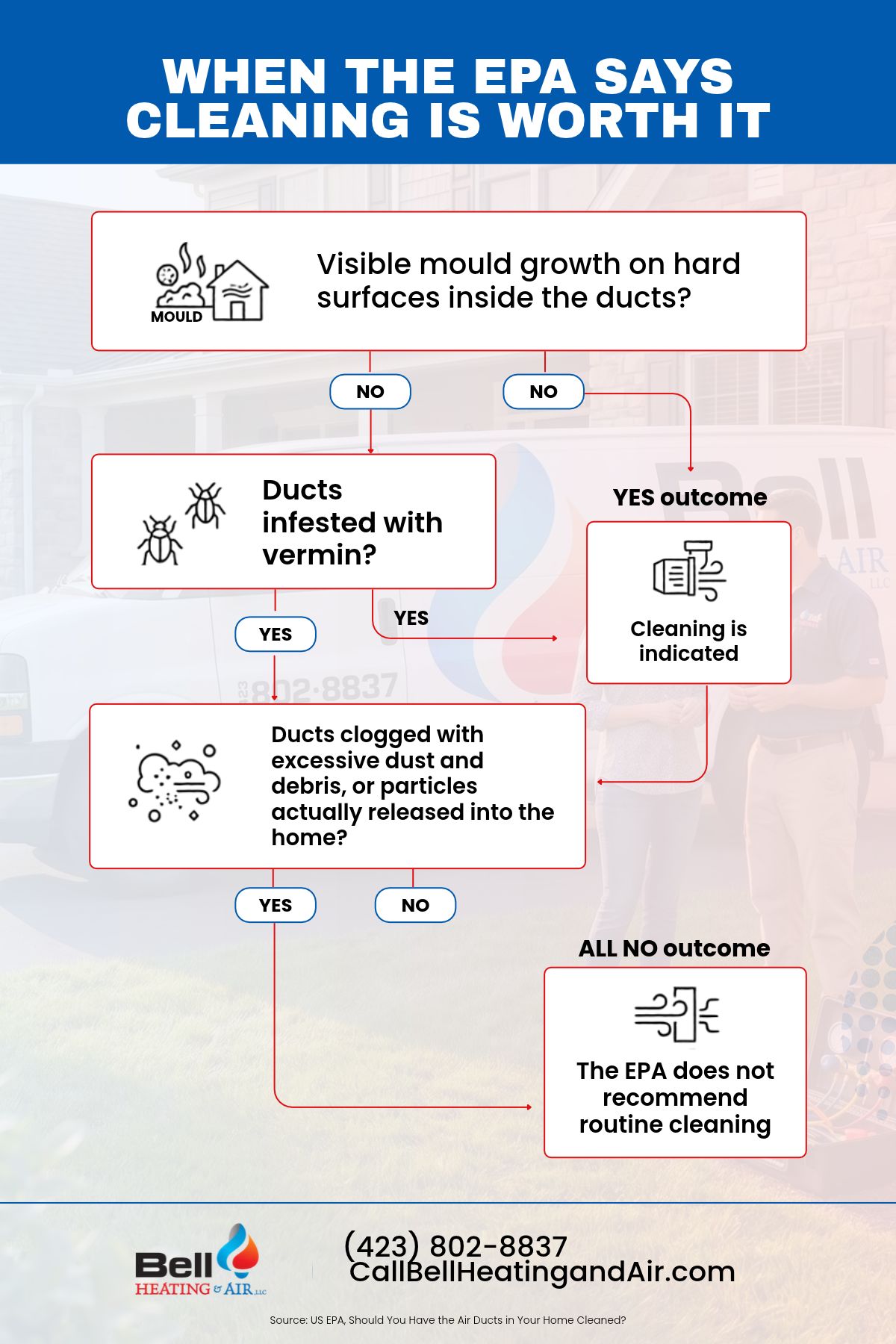
The federal agency that studies indoor air says there is no blanket recommendation either way. The EPA states plainly that knowledge about air duct cleaning is in its early stages, that duct cleaning has never been shown to prevent health problems, and that no study conclusively shows dust levels in homes rise because of dirty ducts. It then names exactly three conditions that do justify the work: substantial visible mold growth inside hard-surface ducts or system components, infestation by vermin such as rodents or insects, and ducts clogged with excessive dust and debris, or actually releasing particles into the home from the supply registers. If one of those three applies, cleaning is worth paying for, and there is nearly always an underlying cause that needs fixing too. If none of them applies, the money does more for you spent on filtration, on sealing, or on the maintenance visit that would have found the real problem.
What the EPA Actually Says
This is the source most duct cleaning advertising quietly leaves out, and it is the US government’s own guidance on the subject.
The EPA’s guidance opens by refusing to give the recommendation people want. It says that because knowledge about air duct cleaning is in its early stages, a blanket recommendation cannot be offered as to whether you should have the air ducts in your home cleaned. It goes further and states that duct cleaning has never been shown to actually prevent health problems, and that studies do not conclusively demonstrate that particle levels in homes increase because of dirty air ducts.
The reason it gives is worth understanding, because it changes how you think about your own house. Much of the dirt in air ducts adheres to the duct surfaces and does not necessarily enter the living space at all. Dirty ducts are one of many possible particle sources in a home, and cooking, cleaning, and simply moving around can cause greater exposure than the ducts do. The EPA also states there is no evidence that a light amount of household dust in air ducts poses any risk to health.
None of that means duct cleaning is worthless. It means it is a targeted repair, not a routine service, and the agency is specific about when it is targeted at something real. The full document is the EPA’s guidance on whether to have your home’s air ducts cleaned.
The Three Conditions That Justify the Work
The EPA says you should consider having your air ducts cleaned if any one of these is true.
| Condition | What it looks like |
| Substantial visible mold growth | Inside hard-surface ducts such as sheet metal, or on other heating and cooling components |
| Vermin infestation | Rodents or insects living in the ductwork |
| Clogged or releasing particles | Excessive dust and debris, and/or particles actually coming out of the supply registers into rooms |
Read the third one carefully, because it is the one most often stretched. The test is not that a technician found dust inside a duct. Dust inside a duct is normal, and the EPA says so. The test is whether the ducts are clogged with excessive debris, or whether debris is actually being released into the home from the registers, which is something you can usually see happening.
The mold condition has conditions of its own
The EPA attaches several cautions to the mold criterion, and together they form the most useful consumer protection in the whole document.
Many parts of a heating and cooling system cannot be seen, so the agency’s advice is direct: ask the service provider to show you any mold they say exists. It also notes that a substance can look like mold without being mold, that only an expert can make a positive determination, and that some microbiology laboratories will test a tape-lift sample for around fifty dollars.
Two further points matter more than the cleaning itself. If insulated air ducts get wet or moldy, the insulation cannot be effectively cleaned and should be removed and replaced. And if the conditions that caused the mold growth are not corrected, the mold will simply come back.
That last line is the reason we treat a positive finding as a diagnosis rather than a job. Mold in a duct system means moisture is getting somewhere it should not, and cleaning without finding the moisture is paying to reset a clock.
How to Tell a Real Duct Cleaning From a Sold One
The industry has its own standard, and knowing two things from it gives you a straightforward way to test whoever is quoting you.
The National Air Duct Cleaners Association published the 2025 edition of ACR, its standard for the assessment, cleaning, and restoration of HVAC systems, on September 24, 2025. Among its stated purposes, the association promotes source removal as the only acceptable method of cleaning. The standard also sets out cleanliness verification methods, naming the Surface Comparison Test and the NADCA Vacuum Test. The announcement and the free download are in NADCA’s release of the 2025 ACR standard.
Those two facts turn into two questions:
- Is this source removal? Contaminants are physically removed from the system under containment, not blown around or chemically treated in place.
- How will you verify it? A contractor working to the standard has named verification methods available and can tell you which one they use.
A quote that cannot answer either question is selling something other than the standard it is implying.
It is worth knowing what source removal means in practice, because the phrase is used loosely in advertising. The system is put under negative pressure so that anything dislodged travels into collection equipment rather than into the house, and the debris is agitated loose and physically extracted. A visit that consists of blowing compressed air into registers, or of fogging a chemical through the system, is not that. Chemical treatment in particular is a separate decision with its own considerations, and it is not a substitute for removing what is in there.
The containment step is also the part a homeowner can see happening. If nothing is sealed off and no collection equipment is connected before work starts, the job is not being run the way the standard describes, whatever the invoice says.
The flyer price is the tell
A whole-house price offered before anyone has looked at the system is quoting a job that has not been scoped. The EPA’s three conditions all require somebody to inspect first, and the mold condition explicitly requires that you be shown the evidence.
What Usually Causes the Dust You Are Actually Seeing
Most people asking about duct cleaning in Chattanooga are not asking an academic question. They have a dusty house, or a smell, or a room that never feels right, and duct cleaning is the service they have heard of.
More often, the cause is one of these, and each has a different fix.
Filtration is the first place to look. The filter is the system’s real defense against circulating dust, and it is the cheapest item on this list to get right. Air filtration and higher-grade filtration systems address it directly.
Leaky return ducts come next. A return leak does not simply lose air; it pulls unconditioned and unfiltered air in from wherever the leak is, which around here often means a humid crawlspace. That is a duct repair question rather than a cleaning one.
Then there is duct design that never suited the house. Undersized returns and awkward layout produce pressure problems no amount of cleaning changes, and that is ductwork work.
Last, ventilation that is not moving moisture out. Bathroom and kitchen exhaust fans that discharge into an attic rather than outside are a moisture source, and moisture is the precondition for the mold that would justify a cleaning in the first place. Ventilation services cover that.
Notice that three of those four are moisture or air-path problems. In a climate with our humidity, the duct system is usually reporting a problem rather than being one.
The Musty Smell on the First Cold Morning
Every fall, usually somewhere between the first football weekends and Halloween, the phone rings about a smell, and it arrives in the same week the heat comes on for the first time. It is worth separating from the duct question because the two get confused.
A system that has sat unused through a mild spell has dust settled on a heat exchanger and on burner surfaces. When heat is applied to it the first time, that dust burns off, and it smells like it. That version fades within a short run and does not come back.
A musty or damp smell is a different report. It tends to appear when the blower starts rather than when the heat does; it does not fade, and it often gets stronger in humid weather. That pattern points to moisture somewhere in the air path: a coil that is not draining, a return pulling from a damp crawlspace, or insulation that has been wet.
The distinction matters because only the second one is heading toward the EPA’s mold condition. And the EPA is explicit that mold has to be seen and shown, not assumed from a smell.
| What you notice | Where it usually points |
| Burning or hot-dust smell on the first heat cycle, fading | Dust burning off, normal |
| Musty smell whenever the blower runs | Moisture in the air path, worth inspecting |
| Smell stronger in humid weather | Return or crawlspace air being pulled in |
| Visible growth on accessible components | The EPA’s first condition: ask to be shown it |
Any smell that comes with a headache, nausea, or other symptoms in anyone in the house is a different conversation and should be treated as urgent rather than diagnosed from a table: get everyone outside and call 911 or your gas company, because it can be a sign of carbon monoxide.
Where a Cleaning Genuinely Earns Its Place
Having spent most of this page on skepticism, it is worth being equally clear about when the answer is yes.
Renovation dust is the clearest case. A house that has had drywall sanded, floors cut, or a wall opened while the system was running- often during a remodel rushed to finish before family arrives for Thanksgiving or Christmas- has debris in the ducts that did not settle there gradually, and it can be released back into rooms. That is the EPA’s third condition, met literally.
A confirmed rodent or insect infestation is the second, and it is not a judgment call once you have seen it. A new house where the system ran during construction is a common version of the first case. And a system that has had genuine water intrusion sits in the mold category, where the honest recommendation may be replacing insulated sections rather than cleaning them.
In each of those, cleaning is part of a repair with a cause behind it. That is the difference between a service and a sale.
There is also a case the EPA’s three conditions do not cover, and one homeowners raise often: buying a house. You have no history on the system, no idea whether the previous owners smoked or kept animals indoors, and no way to know whether the ducts ran through a renovation. Nothing about that automatically justifies a cleaning, but it does justify getting the system looked at properly before the first heating season, because an inspection settles the question either way and finds the maintenance backlog at the same time.
The same reasoning applies after a rodent problem has been dealt with elsewhere in the house. Once the infestation is confirmed and resolved, the ductwork is worth checking rather than assumed clean, and that is the EPA’s second condition being tested rather than presumed.
What an Inspection Should Settle First
Before any cleaning is quoted, somebody should have looked at the system and told you which of the three conditions applies, if any.
A proper HVAC inspection covers the components, the airflow, and the moisture picture, and it is what turns a suspicion into a finding. If none of the three conditions is present, that inspection has still earned its money, because it will usually have found the thing that actually explains the dust. Routine seasonal maintenance is where most of these get caught early, and early fall, before the house fills up with family and holiday guests, is the natural time for it.
If you are weighing up contractors more generally, our notes on questions to ask your local HVAC contractors apply here too.
Get the System Looked At Before You Buy a Cleaning
If a flyer has you wondering, the right next step is not a duct cleaning quote; it is somebody establishing whether you have one of the three conditions that make it worth doing. Bell Heating & Air covers indoor air quality across our service area, and we will tell you when the answer is that your ducts are fine.
