
 Chattanooga, TN


 (423) 802-8837
 A humidifier adds moisture to dry air. A dehumidifier removes moisture from damp air. The EPA recommends keeping indoor relative humidity below 60 percent and ideally between 30 and 50 percent, and that target is the whole game.
In Chattanooga, summer is a dehumidifier problem. The outdoor air is heavy, and even with the air conditioning running, the house can feel clammy and sit above 55 or 60 percent humidity. Winter flips it. Heating dry outdoor air drives indoor humidity down into the 20s, which is why you get dry skin, static shocks, and a scratchy throat in January. So for most homes here, it is not one or the other. It is a dehumidifier for the warm months and, often, a humidifier for the cold ones, both aimed at that 30 to 50 percent band.
Here’s What Most People Get Wrong
If you have been trying to decide between the two, or you bought one and the problem did not go away, the issue is usually that you were solving for the wrong season.
Below is what indoor humidity actually does to a house and the people in it, why Chattanooga’s climate creates two opposite problems across the year, how to measure where your home actually sits before you buy anything, when a whole-home system beats a portable unit, and the specific case where a house genuinely needs both a humidifier and a dehumidifier working at different times.
Why Indoor Humidity Is Worth Getting Right
Humidity is not just a comfort preference. It affects your health, your house, and your energy bill, in both directions.
Too much moisture, above roughly 60 percent, is the bigger problem in this climate. It gives mold and mildew what they need to grow, feeds dust mites, makes a 74-degree house feel sticky and warmer than it is, and can leave a musty smell that never quite clears. It also makes your air conditioner work harder, because a big part of what an AC does in summer is pull moisture out of the air.
Too little moisture, below roughly 30 percent, causes its own trouble. Dry air pulls moisture out of skin, sinuses, and wood. That shows up as chapped skin, nosebleeds, more static, worse cold and flu symptoms, and over a winter or two it can shrink hardwood floors and trim until gaps and cracks appear. Dry air also feels colder than it is, which tempts people to turn the heat up and spend more.
The 30 to 50 percent range is the sweet spot because it sits below the mold threshold and above the too-dry threshold at the same time. Everything in this article is aimed at keeping a home in that band year-round.
Chattanooga Gives You Both Problems, Six Months Apart
The reason this is confusing here is that the correct answer changes with the season. Chattanooga sits in a humid subtropical climate, and that means two opposite humidity problems in the same house across one year.
In summer, warm air holds a lot of moisture, and the Tennessee Valley delivers plenty of it. Your air conditioning removes some as it cools, but on humid stretches, and especially in a house that cools quickly without running long enough to dry the air, indoor humidity climbs past comfortable. This is the season a dehumidifier earns its keep, and it is also tied to why an oversized air conditioner can leave a house cool but clammy.
In winter, the outdoor air is cold and dry, and heating it makes it drier still. Every time your furnace warms that air, the relative humidity drops, and a tight, well-sealed home can fall into the low 20s. That is the season a humidifier helps, adding back enough moisture to stay comfortable and protect the woodwork.
Spring and fall are usually the easy stretches, when outdoor conditions sit closer to that ideal band, and neither device has much to do. The early-fall exception is a full house. Every person in the room adds moisture, so a den packed for a Vols, Bulldogs, or Crimson Tide game can feel muggy even when the weather outside is mild. The mistake is buying for the season you are standing in and forgetting the opposite one is six months away.
Older Chattanooga homes and newer ones sit at opposite ends of this problem, which is worth knowing before you assume your house behaves like your neighbor’s. A drafty older home leaks air constantly, so it tends to track the outdoor conditions more closely: quite humid in summer, but not as brutally dry in winter, because outdoor air keeps sneaking in. A tightly sealed modern home holds whatever it has, which is good for the energy bill but means summer moisture gets trapped and winter heating drives the air very dry with nothing leaking in to soften it. That is why some of the driest winter interiors and stickiest summer ones show up in the best-built houses, and why the answer really is house-by-house rather than a rule of thumb.
Measure First, Then Decide
Before spending a dollar, find out where your home actually sits. Guessing from how the air feels is unreliable, because temperature strongly colors our sense of humidity.
Buy an inexpensive hygrometer, the small digital kind that reads relative humidity, and put one in the main living area and one in a bedroom. Read them across a few days in the current season, then again when the season turns. What you are looking for is simple: readings consistently above 55 to 60 percent point to a dehumidifier need, readings consistently below 30 percent point to a humidifier need, and a house that crosses both lines across the year is the both-systems case.
This step matters because the symptoms overlap and mislead. A stuffy, stale feeling can come from high humidity or just poor ventilation. Dry skin in winter is obvious, but few people realize their summer allergies are partly a humidity and mold issue. A number on a hygrometer settles it, and it tells a contractor exactly what to size a solution around. It also gives you a way to check that whatever you install is actually working, since you can watch the reading move into the target band.
Portable Units Or A Whole-Home System
Once you know the direction, the next question is scale. Portable and whole-home options both have a place, and the right call depends on how much of the house has the problem.
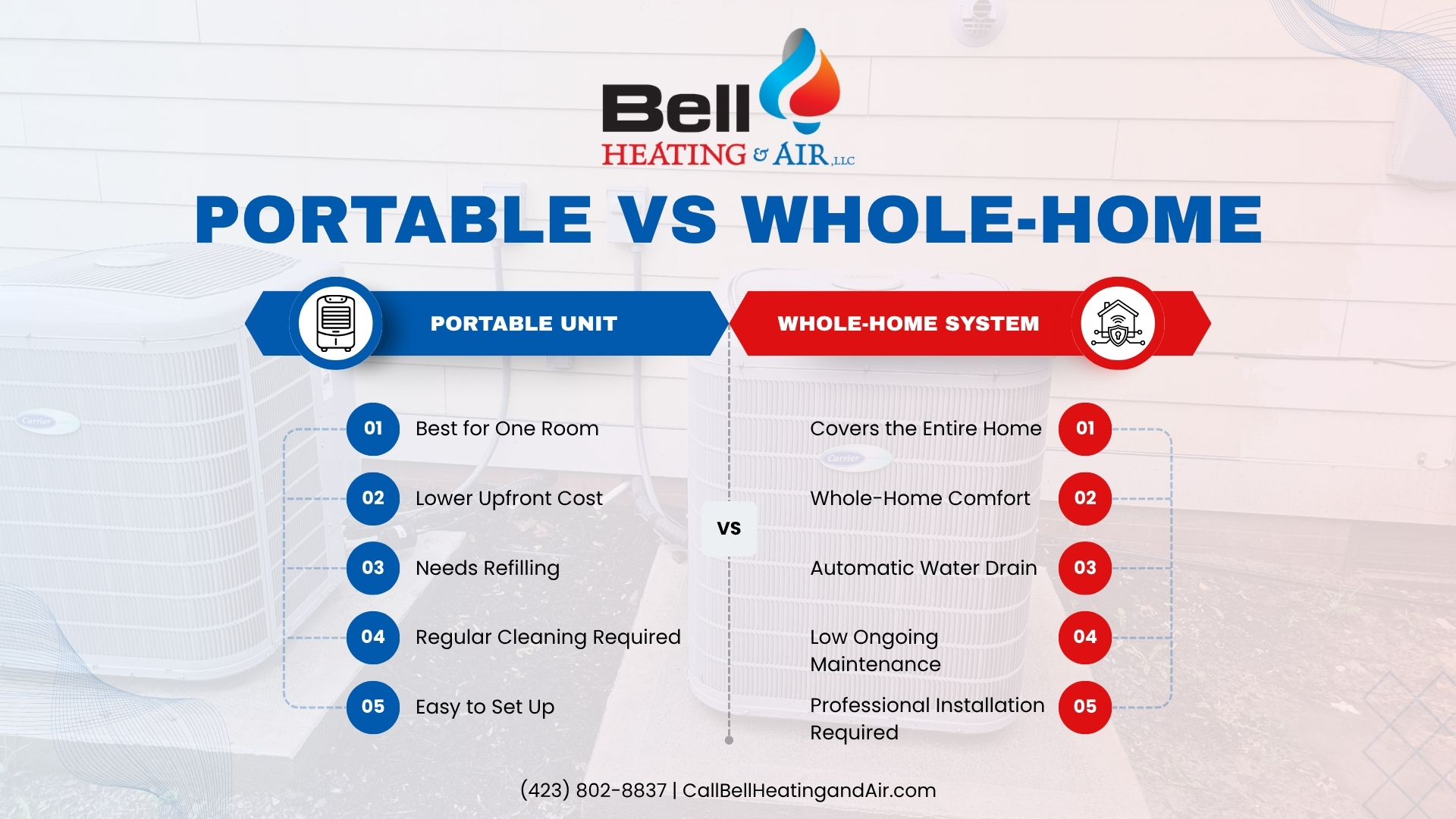
A portable unit makes sense for a single room, a damp basement, a nursery in winter, or for testing whether managing humidity fixes a specific complaint before committing to more. They are cheap to buy, they work, and they have real limits: they only treat the space they sit in, portable dehumidifiers need their tanks emptied constantly in a Tennessee summer, and portable humidifiers need refilling and regular cleaning or they grow their own mildew.
A whole-home humidifier or dehumidifier is built into the ductwork and treats the entire house from one unit, controlled off a humidistat the way your thermostat controls temperature. Whole-home dehumidifiers drain automatically instead of asking you to empty a tank, and whole-home humidifiers tie into the plumbing so they refill themselves. For a house that has the problem in more than one room, which is most houses here, the built-in approach is less hassle and more consistent, and it is the sensible pairing with the heating and cooling system that is already moving air through those ducts.
The trade-off is upfront cost and professional installation, since these tie into ducts, drains, and the electrical system. For a whole-house problem, that cost usually buys back its worth in comfort and in not fighting a row of portable units all season.
How Humidity Ties Into Your Heating And Cooling Bill
There is a comfort argument for getting humidity right, and there is a money argument, and in this climate they point the same way.
In summer, humidity is a big part of why a house feels hot. Sweat cools you by evaporating, and when the air is already saturated, it evaporates poorly, so a humid 74-degree room feels warmer than a dry one at the same temperature. Homeowners respond by dropping the thermostat two or three degrees to chase comfort, which runs the air conditioner harder and longer. Pulling the humidity down instead often lets the same house feel comfortable at a higher thermostat setting, which is where the savings come from. A dehumidifier is not free to run, but it targets the actual source of the discomfort rather than overcooling the whole house to mask it.
Winter works in reverse. Dry air feels colder than its temperature, so a house at 30 percent humidity in January feels chillier than the same house at 40 percent, and people nudge the heat up to compensate. Adding a modest amount of moisture lets the same room feel comfortable a degree or two lower on the thermostat. Neither effect is enormous on its own, but they run for months at a stretch, and a system that holds the house in the right band the whole season adds up.
There is a wear angle too. An air conditioner that short-cycles, cooling the air quickly but never running long enough to wring moisture out of it, leaves a house cool and clammy and does more starting and stopping, which is hard on the equipment. Sorting the humidity side sometimes reveals that the real issue was a cooling system that was never sized or set up to dehumidify properly in the first place, which is a conversation worth having with a contractor.
When A Chattanooga Home Needs Both
Here is the case the one-or-the-other framing misses entirely, and it is common in this area.
A well-built, well-sealed Chattanooga home frequently runs too humid in July and too dry in January. The same house, the same rooms, opposite problems across the year. Neither a humidifier alone nor a dehumidifier alone keeps that home in the 30 to 50 percent band year-round, because each only pushes in one direction.
The practical solution is a whole-home dehumidifier for the cooling season and a whole-home humidifier for the heating season, both wired to a humidistat so they hand off automatically as the seasons change. You are not running both at once. You are running the right one for the current conditions, and the controls make the switch without you thinking about it.
This is exactly the kind of question worth putting to a local contractor who knows Tennessee Valley homes, because the answer depends on your specific house: how tight it is, how the ducts run, how the air quality services already in place are performing, and what your hygrometer readings actually show across the year. A house built in 1955 with leaky windows has a very different humidity profile than a sealed 2020 build, and the right setup follows from that.
Bringing it all together
The useful reframing is to stop asking humidifier vs dehumidifier as an either-or and start asking what your home needs in each season. A Chattanooga house usually needs moisture removed in the humid summer and moisture added in the dry winter, with the whole thing aimed at the 30 to 50 percent band the EPA points to. Measure first with a cheap hygrometer, decide portable versus whole-home based on how many rooms have the problem, and accept that for a lot of homes here the real answer is both, handled off by a humidistat across the year. If you want that sorted for your specific house, Bell Heating & Air, LLC can measure where your home sits and recommend the setup that keeps it in range through a full Tennessee Valley year.
