
 Chattanooga, TN


 (423) 802-8837
 Rinse the filters every one to two months while the system is running hard, and closer to every three months if the unit sees light use. That part is genuinely a homeowner job, and it takes ten minutes.
The part that matters more is the coil and the blower wheel, which need a proper cleaning about once a year in a humid climate, and a full teardown deep clean somewhere in the three- to five-year range depending on how the unit has been used. Mold and grime collect on the blower blades and deep in the coil fins, which is exactly where a filter rinse never reaches. If your unit smells musty when it first kicks on, that smell is coming from those surfaces, and no amount of filter cleaning is going to fix it.
Here’s What Nobody Tells You When They Sell You Ductless
Mini splits get sold on low running costs and quiet operation, and they deliver on both. What does not come up during the sales conversation is that the indoor head is a small, damp, dark box hanging on your wall, and in the Tennessee Valley that box is working against the climate all summer.
Below is what actually accumulates inside one and why the design makes it inevitable, why the filter you have been diligently rinsing is not doing the job you think it is, how the honest cleaning intervals differ from the ones printed in a manual written for a milder climate, when a musty smell means you need a deep clean rather than another rinse, and how to tell a legitimate deep clean from an upsell. Some of this argues against selling you things, which is rather the point.
Myth 1: Cleaning The Filter Means The Unit Is Clean
This is the big one, and it is understandable, because the filter is the only part the manual tells you to touch.
The trouble is that mini splits are not well filtered to begin with. As building science writer Allison Bailes puts it, they “don’t have good filtration. The air passes through a pretty thin filter that doesn’t fit tightly across the coil.” A thin filter that does not seal at the edges means a meaningful share of the air, and everything riding in it, goes around rather than through.
There is a second path in that people rarely consider. The outlet at the bottom of the unit is open to the room, so humid, dirty air can reach the cold surfaces inside without passing the filter at all. The filter is guarding one door in a room with two.
So the filter does a real but limited job. Rinsing it keeps airflow up and keeps the worst of the dust out. It does not keep the inside of the machine clean, and treating it as though it does is how units end up in the state described below.
Myth 2: No Ducts Means No Maintenance
The pitch that ductless systems avoid the dirty-duct problem is true as far as it goes. What it skips is that the mess simply relocates.
In a ducted system, dust settles across a large duct surface, and a big filter catches a lot of it. In a ductless head, all of that lands on two components: the evaporator coil and the blower wheel. The blower wheel is the cylindrical cage of thin blades that flings the air out into the room, and it is the worst affected part in the whole system.
Bailes explains why plainly: “all those cold, wet blades are pushing the air and removing the particles.” The blades are below the dew point, so they are wet. Wet blades catch dust the way a damp cloth does. Dust plus moisture plus darkness is the standard recipe for mold, and the blower wheel supplies all three at once, every cooling hour of the summer.
You cannot see any of this from the room. The blower wheel sits behind the coil, and looking into the outlet slot from below shows you almost nothing.
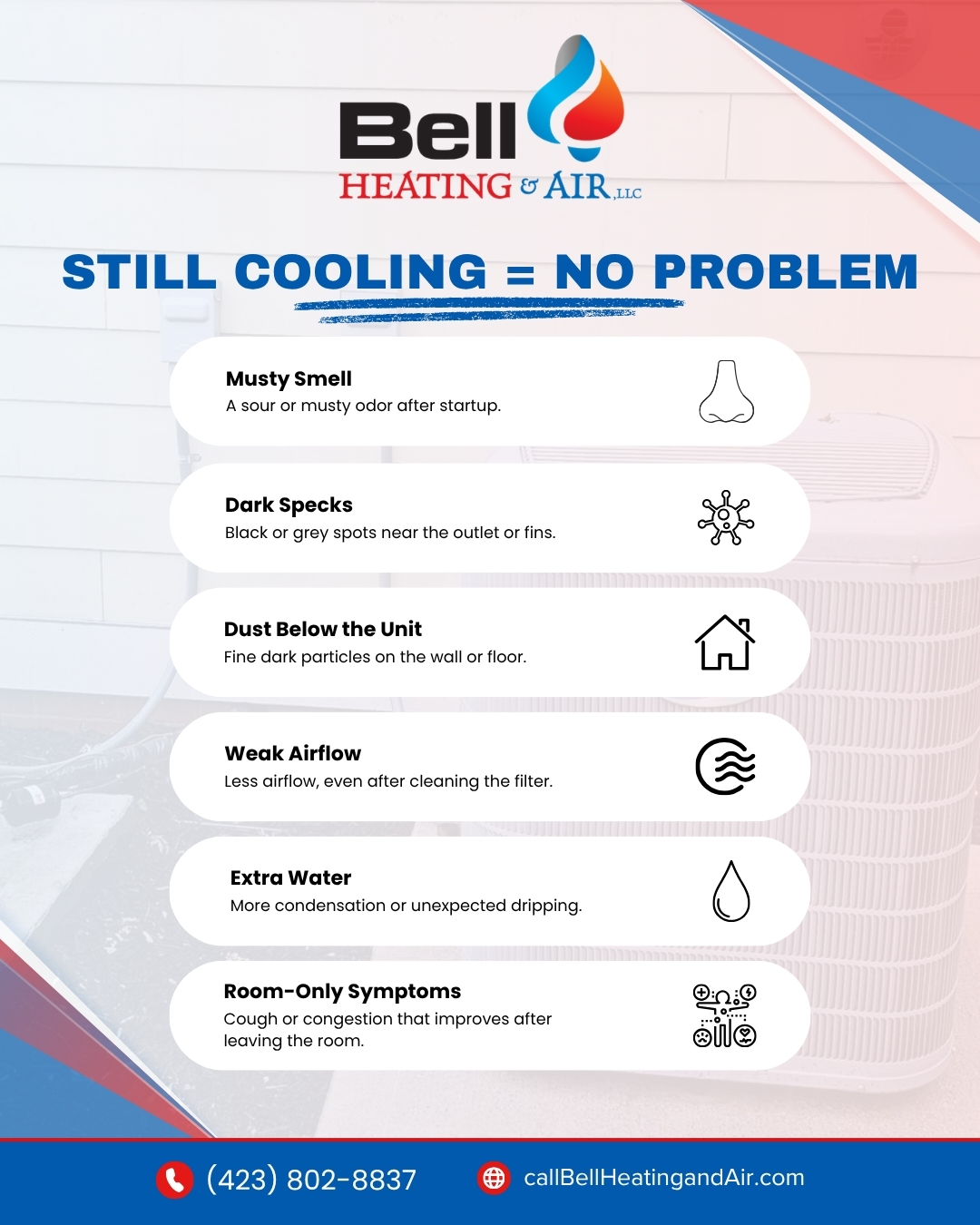
Myth 3: If It Is Still Cooling, It Is Fine
Cooling performance is a lagging indicator. A unit can be visibly filthy inside and still hit the set temperature, particularly in spring and autumn when it is barely working.
Watch for these instead, roughly in the order they usually show up:
- A musty or sour smell in the first few minutes after startup, strongest when the unit has been off a while
- Black or grey speckling visible on the fins or just inside the outlet slot
- Fine dark specks appearing on the wall or floor below the head
- Airflow that feels weaker than it used to, even right after a filter rinse
- More condensate than usual, or water dripping where it did not before
- Someone in the house with a cough or congestion that improves when they leave the room
The smell is the one to act on. It is the most reliable early sign, and it is caused by growth on surfaces you cannot reach, which means it is telling you something a visual check cannot.
It’s especially common in a bonus room or basement den where the unit sits off most of the week, then runs hard for a full room on game day.
There is a related failure worth knowing about, because it turns a cleaning issue into a water issue. As grime builds inside the head, some of it washes down into the condensate pan and then into the drain line. That line is narrow, and it runs on a shallow slope. Once it partly blocks, condensate backs up in the pan, and the first sign is usually water staining the wall under the unit or dripping onto the floor. People understandably call that a leak, and it is, but the cause is upstream. A unit that has been quietly getting dirty for six summers is often the one that suddenly “starts leaking” in July, which is also the month it is running hardest and producing the most condensate.
That is the practical argument for treating the yearly service as a whole job rather than a coil rinse. Clearing the drain line is part of it, and doing that once a year in this climate is cheap insurance against drywall repair.
Myth 4: One Yearly Clean Is Enough Anywhere
Manufacturer intervals are written for an average, and Chattanooga is not the average. We are in a humid sHumidpical climate, and humidity is the single biggest driver of how fast a mini-split gets dirty inside.
The mechanism is straightforward: “humid climates provide a lot of airborne water to wet things down. You can still get a dirty mini-split in a dry climate, but it probably won’t get as bad or happen as quickly.” Same unit, same filter habits, different outcome, purely because of the air it is sitting in.
| Task | Who does it | Humid climate interval |
| Rinse or vacuum the filters | Homeowner | Every 1 to 2 months in heavy use, 3 months in light use |
| Wipe the visible coil face and outlet louvres | Homeowner | With each filter clean |
| Clear and flush the condensate drain line | Homeowner or tech | Yearly, before cooling season |
| Coil and blower wheel cleaning | Technician | Yearly |
| Full teardown deep clean | Technician | Every 3 to 5 years, sooner if odour returns |
That means a schedule copied from a manual, or from a contractor in Denver, will under-service a unit here. Here is a realistic set of intervals for this climate: Units that run nearly continuously, sit in a kitchen, or share a house with pets or smokers move to the short end of every one of those ranges. A guest room head used six weeks a year can sit at the long end without any trouble.
Myth 5: A Can Of Spray Cleaner Handles It
There is a category of aerosol “coil cleaner” sold for exactly this, and it mostly does not work for the reason people buy it.
Spraying foam into the coil face treats the front of the coil. The growth causing the smell is generally on the back side of the blower wheel and deep in the fin pack, and the spray does not reach those. Worse, whatever the foam loosens has to drain somewhere, and if the condensate pan and line are not cleared first, you have moved the problem into the drain and created a clog.
A real deep clean means the technician pulls the cover, protects the wall and floor with a collection bib, removes the blower wheel where the design allows, and washes the coil and wheel with a proper cleaner and controlled water, then flushes the pan and line. It is a longer job than most people expect the first time, and that is the honest reason it costs what it does.
If someone quotes a mini split deep clean over the phone in under two minutes without asking how many heads you have, how old they are, or whether there is a smell, be a little wary. Those answers change the job substantially.
The Short Version, And The Case Nobody Warns You About
Rinse filters every one to two months in season. Book a coil and blower cleaning once a year, and make sure the mini split maintenance visit includes the condensate line rather than just the coil face. Escalate to a deep clean when a musty smell shows up and does not clear, or every few years regardless.
If you inherited a system with a house and nobody can tell you when it was last serviced properly, treat that as a deep clean due now rather than a yearly clean. It is common to open a unit that has had ten years of dutiful filter rinsing and find the wheel packed solid, because the owner was doing everything the manual asked and the manual asked for the wrong thing.
Multi-head systems deserve a specific warning. A single outdoor condenser often serves three or four indoor heads, and they rarely wear evenly. The head in the main living space runs most of the year and gets filthy; the one in the spare bedroom barely runs at all. Homeowners tend to judge the whole system by the unit they see and hear every day, so a guest-room head can go a decade untouched. It is also the one most likely to sit unused for long humid stretches, which is precisely the condition growth likes. When you book a service, book every head, not the one that smells.
The same goes for units in kitchens. Cooking grease carries in the air, lands on the same cold wet blades, and turns ordinary dust into a sticky film that traps far more than dust alone would. A kitchen head is on the short end of every interval in the table above, and there is no realistic homeowner workaround for it.
One last honest note. If a unit is fifteen years old, has never been opened, and is showing heavy growth, a deep clean can still be the right call, but it is worth asking whether the money is better spent toward replacement. A good contractor will tell you which situation you are in rather than selling the clean either way. That is a fair question to put directly to whoever you call, including us.
Where to go from here
The short answer to how often to clean a mini split is that there are two schedules, not one, and almost everyone is only running the easy one. Filters are yours, every month or two. Coil and blower wheel are a technician’s job, once a year in a climate like Chattanooga’s, with a deep clean every few years or whenever the smell comes back. If your unit has a musty odour on startup, that is not something to add to the spring list; it is growth on surfaces you cannot reach, and it will keep getting worse until someone opens the machine. The team at Bell Heating & Air can tell you which of the two situations you are actually in, usually within a few minutes of taking the cover off.
